Enterprise product discovery for large multi-brand and multi-category retailers

Make the full assortment discoverable - not just the brands and products shoppers already know

Large retail catalogues create a discovery problem that navigation alone cannot solve. Shoppers arrive with an intent - a silhouette, occasion, colour, price point, product type or complete look - while the assortment is organised across brands, categories, variants and markets. RecoMelon connects that intent to relevant products across the eligible catalogue, helping retailers expose more of the range without manually merchandising every relationship.

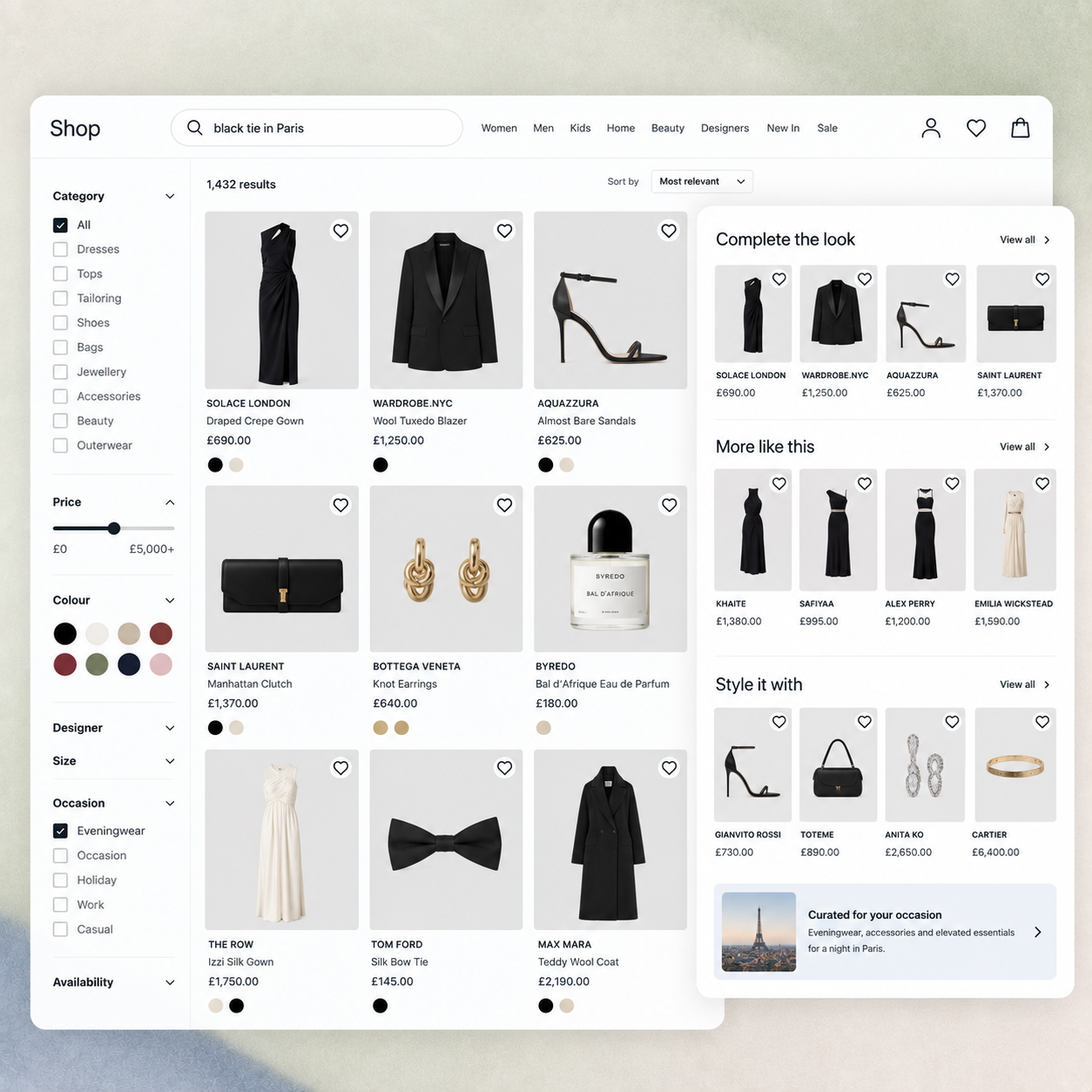
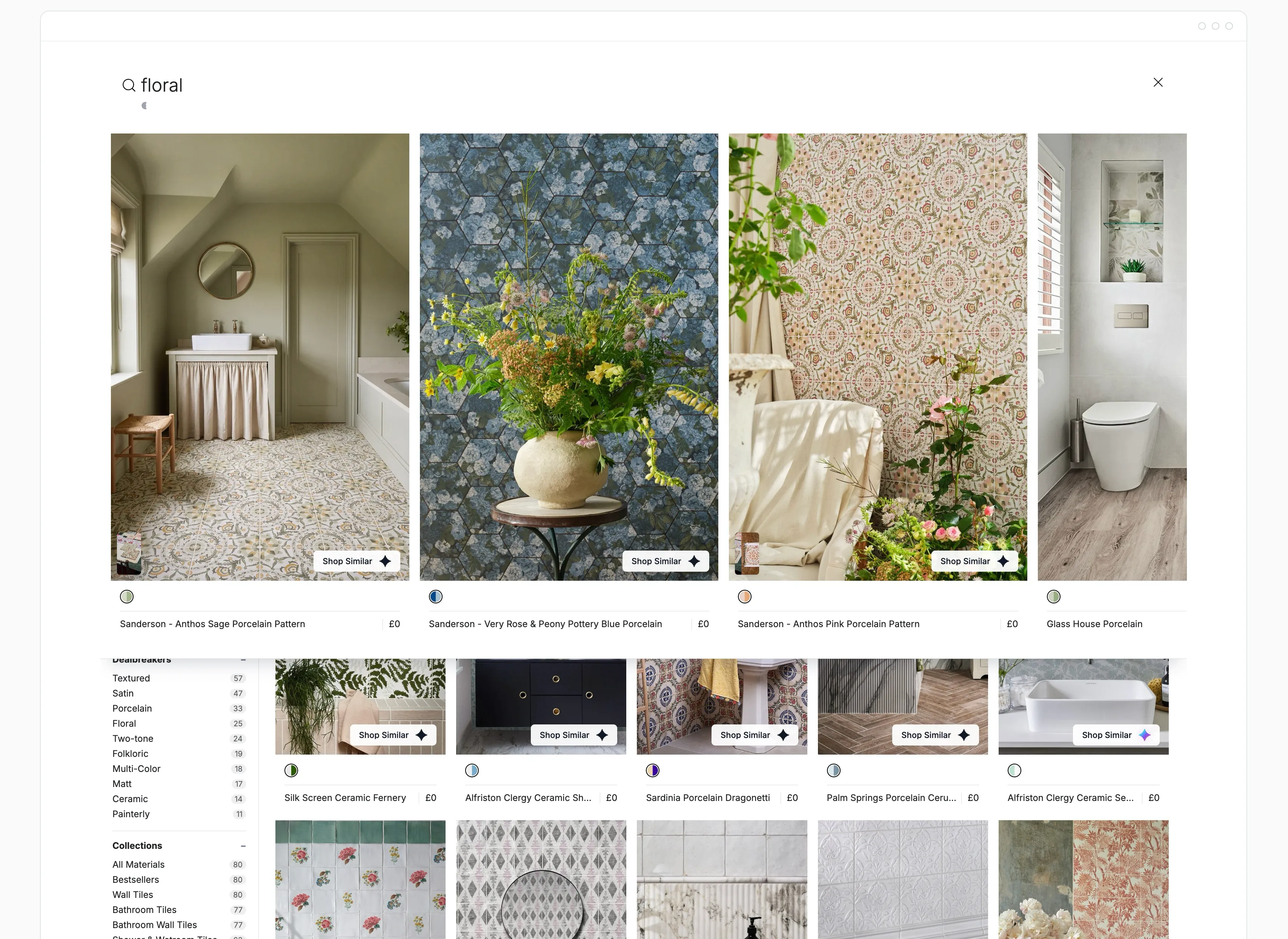
The Index search interface showing a natural language query and matching products

The discovery problem

Your assortment is connected in the shopper’s mind. Is it connected in the storefront?

A shopper looking for a black evening dress, a school-ready outfit, a minimalist trainer or a complete holiday look does not necessarily care how the catalogue is divided internally. The relevant products may sit across different brands, collections, departments and merchandising structures.

At scale, those internal boundaries can become discovery boundaries. Shoppers repeatedly encounter the products that are easiest to search, already popular or manually promoted while relevant new and long-tail inventory remains harder to reach.

RecoMelon creates a product-intelligence layer across the eligible assortment so the next product can follow the shopper’s intent rather than simply the catalogue hierarchy.

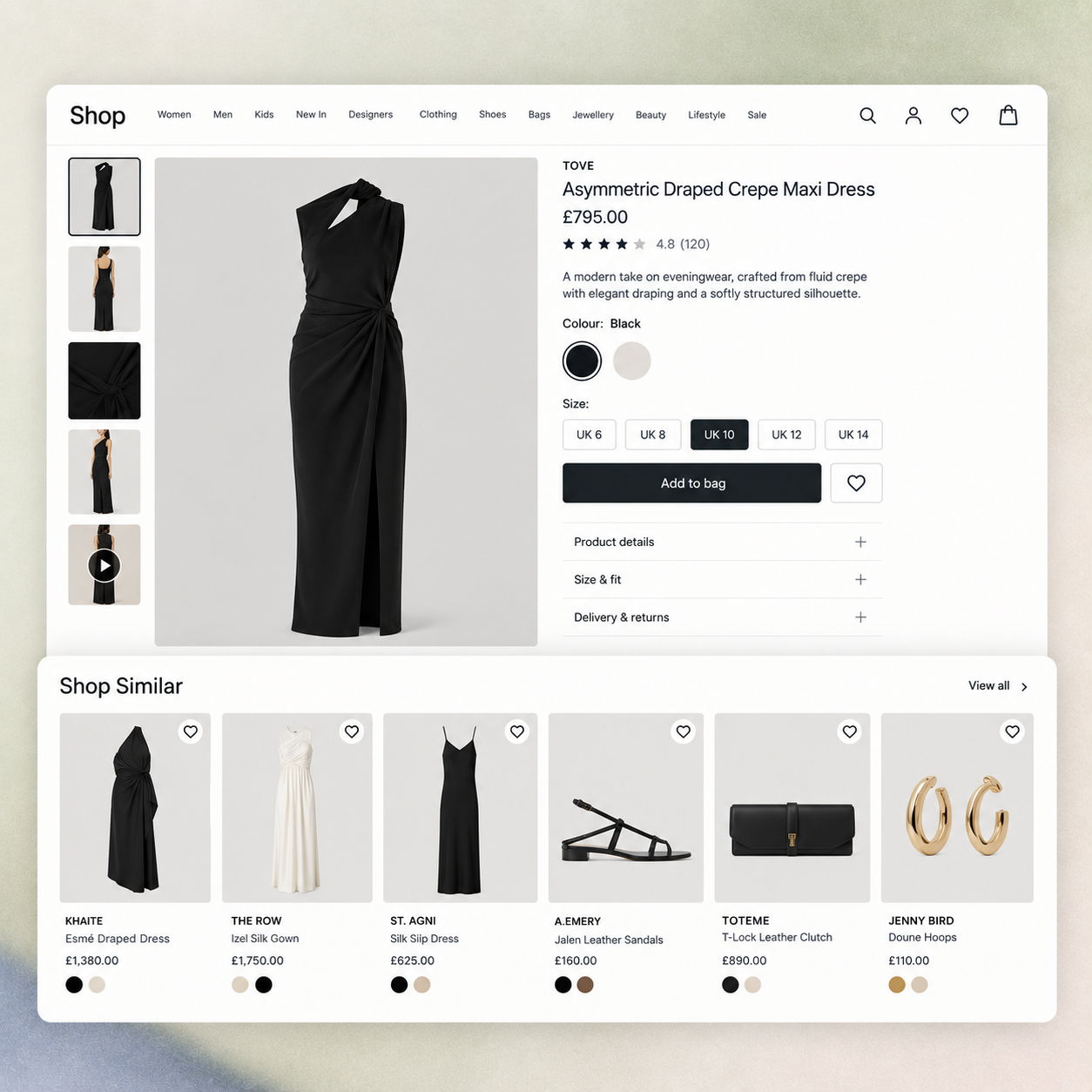
Black evening dress product page with Shop Similar recommendations spanning alternative dresses, footwear, a bag and jewellery across designer and category boundaries.

Across the assortment

Let shopper intent travel further than the category tree.

A large retailer should not have to manually define every useful relationship between products. RecoMelon uses product imagery, catalogue context and the shopper’s current journey to connect relevant choices across the eligible assortment.

VisualDNA™ establishes visual relationships, IntentWeave™ adds usable product intelligence, and RecoMelon surfaces those relationships through search, collections, PDP alternatives and complementary looks. Merchandising teams retain control over the brands, categories, markets and products allowed to participate.

  • Continue the product intent

    When a product is almost right, preserve the characteristics creating desire while changing the likely dealbreaker - such as colour, silhouette, detail, price point or product type.

  • Connect the assortment across brands

    Expose relevant alternatives without requiring identical product naming or a manually maintained cross-brand relationship map.

  • Give newness a route into discovery

    Bring new arrivals and lower-history products into relevant journeys before popularity data has had time to accumulate.

  • Move from alternatives to complete looks

    Use complementary product relationships to connect apparel, footwear, accessories and other eligible categories around the item already creating intent.

  • Keep the experience commercially correct

    Use authoritative catalogue data for price, variants, stock and market eligibility while merchandising controls determine what can be promoted, excluded or prioritised.

Multi-brand search results for black tie in Paris, spanning dresses, tailoring, footwear, bags, jewellery, beauty and outerwear on neutral-grey product backgrounds.

Category-specific discovery

One catalogue intelligence layer. Different discovery logic for every department.

A multi-category retailer should not force dresses, trainers, beauty, childrenswear and accessories through the same recommendation logic. The product relationships that matter change with the category and the shopping mission.

  • Fashion and accessories

    Continue silhouette, colour, occasion and style intent across eligible brands, then move naturally from alternatives into a complete look.

  • Footwear

    Balance visual similarity with authoritative size, variant and availability data so an attractive alternative is also a purchasable one.

  • Kids, baby and family retail

    Keep age, size, category and availability constraints authoritative while using visual and catalogue relationships to widen relevant choice across large seasonal ranges.

  • Beauty and lifestyle

    Use visible shade, format and presentation to support discovery while merchant-supplied product data and compliance rules remain authoritative for suitability and claims.

  • Merchandising control

    Define inclusion, exclusion and commercial priorities by brand, category, market, campaign or assortment so automation expands discovery without flattening the retailer’s buying strategy.

The result is shared intelligence without a one-size-fits-all shopper experience.

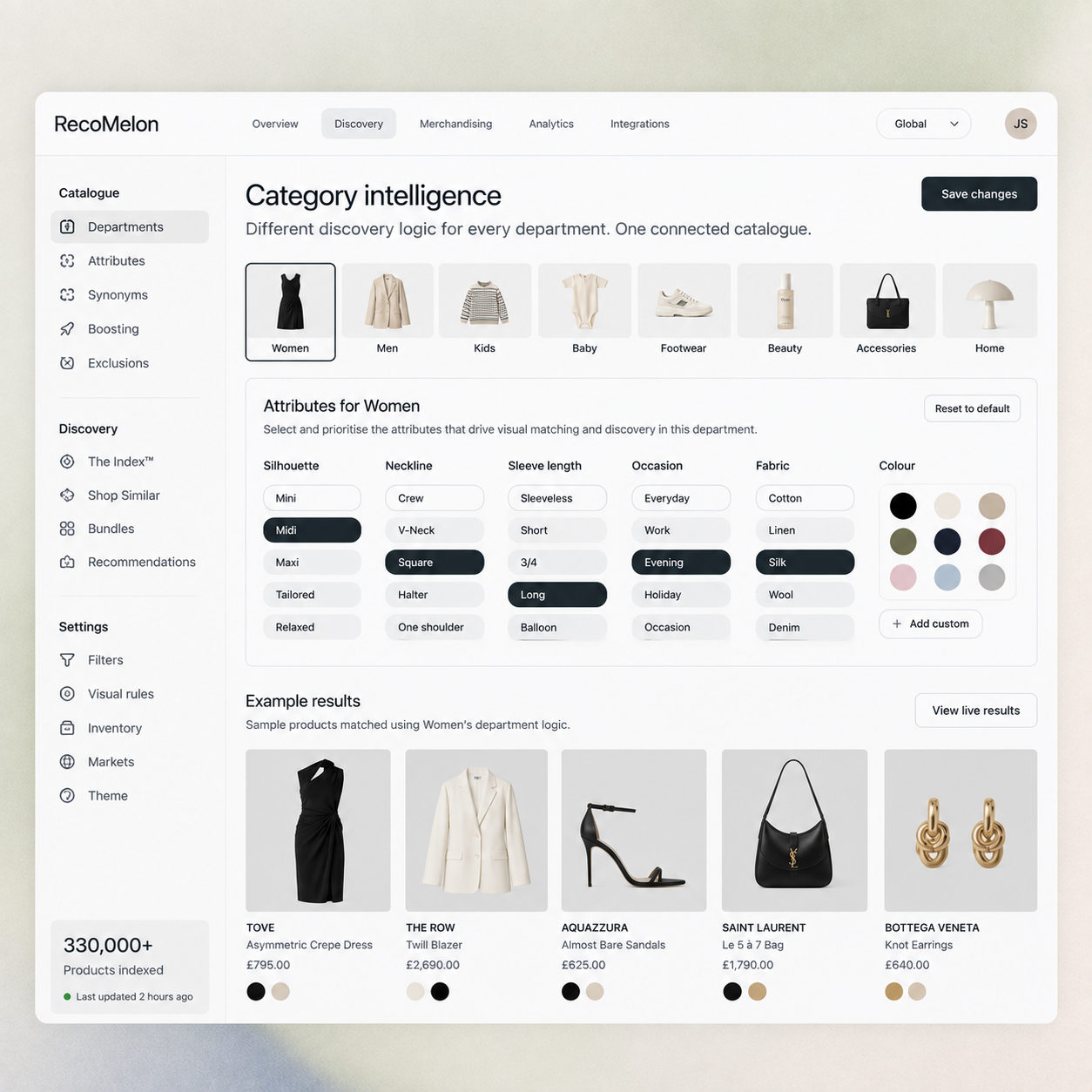
Category intelligence interface with department tabs, configurable visual attributes and example fashion products for department-specific discovery logic.

Inventory-aware outfitting and cross-sell

Turn one product decision into a larger, purchasable basket.

For a multi-brand retailer, complementary discovery is not simply another recommendation carousel. It is the opportunity to turn the product creating intent into a coordinated basket across categories and brands.

Build around the anchor product

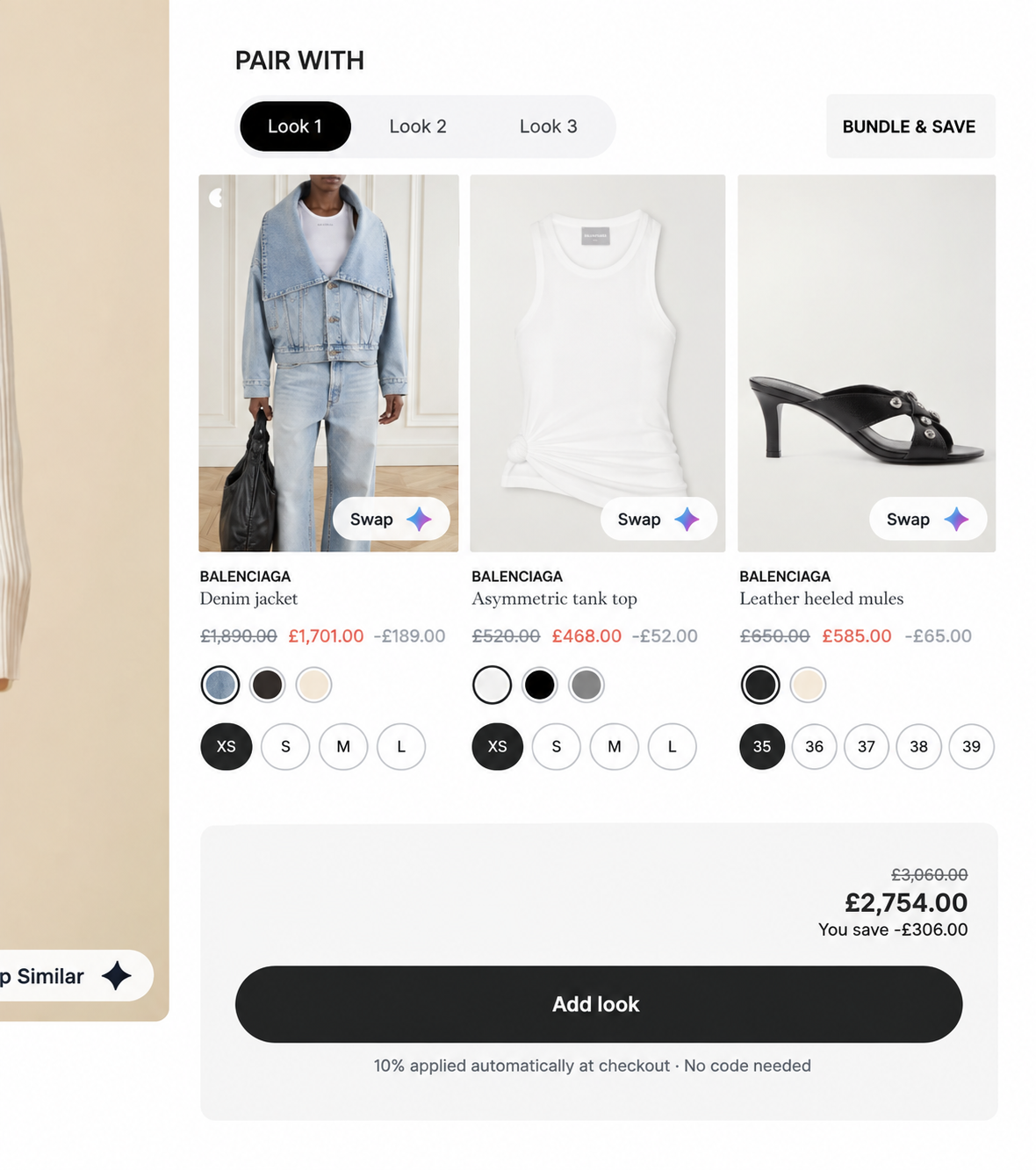
Keep the product the shopper is considering fixed, then introduce distinct companions from eligible product roles - for example footwear, accessories, outerwear or jewellery - rather than returning more versions of the same item.

Respect live availability

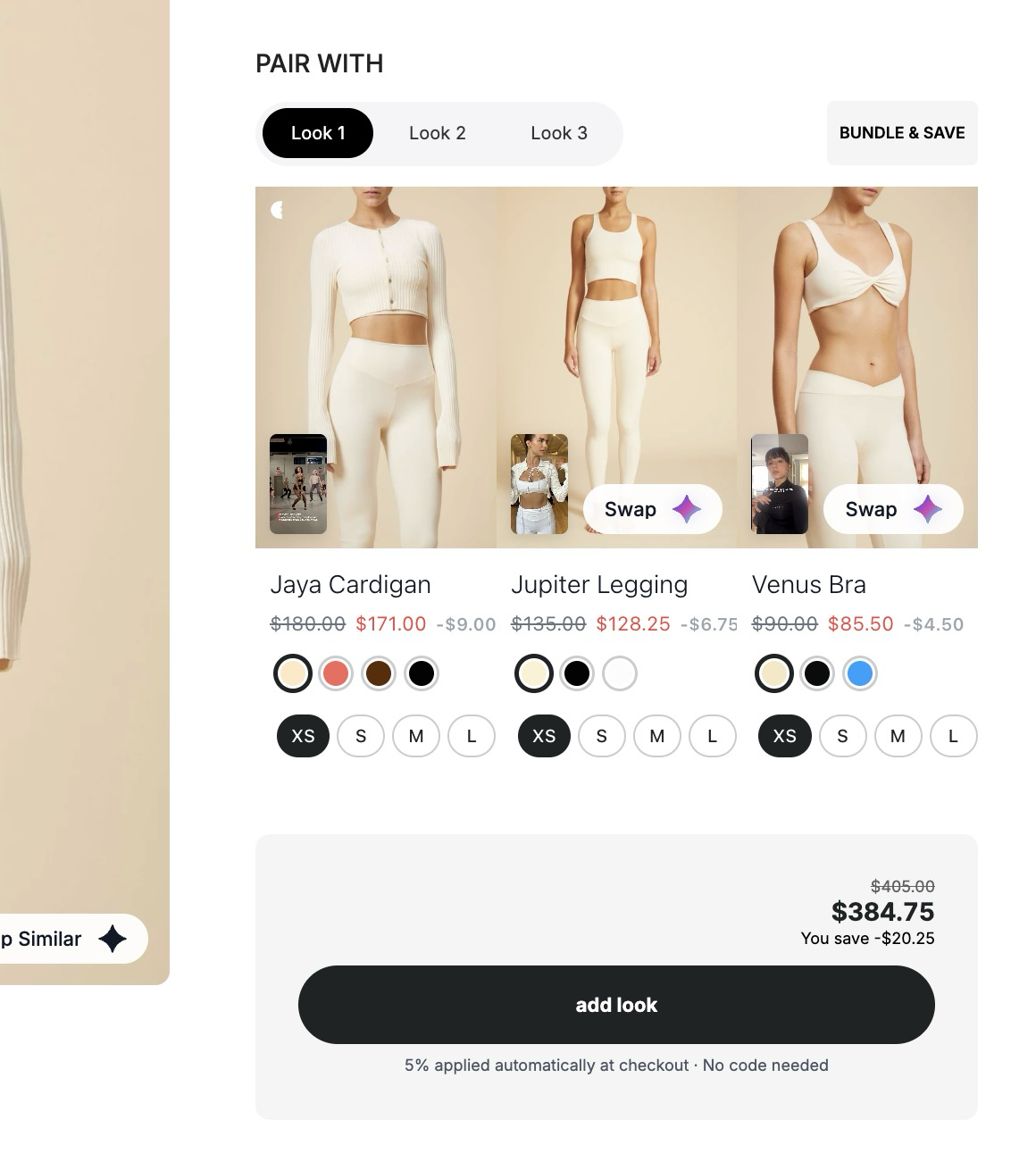
Use current product and variant data to keep recommendations aligned with market, price and stock. If a companion becomes unavailable, Bundle Rescue can offer another eligible visual alternative rather than allowing the look to become a dead end.

Keep commercial strategy in the loop

Control eligible products, category roles, look groupings and offer presentation so complementary discovery supports the retailer’s assortment strategy rather than overriding it.

  • Increase useful cross-category exposure: connect shoppers with products they may not have reached through navigation alone.
  • Preserve shopper choice: allow alternatives and companion swaps without losing the anchor product.
  • Protect purchasability: keep variant, stock and market eligibility authoritative at the point of purchase.
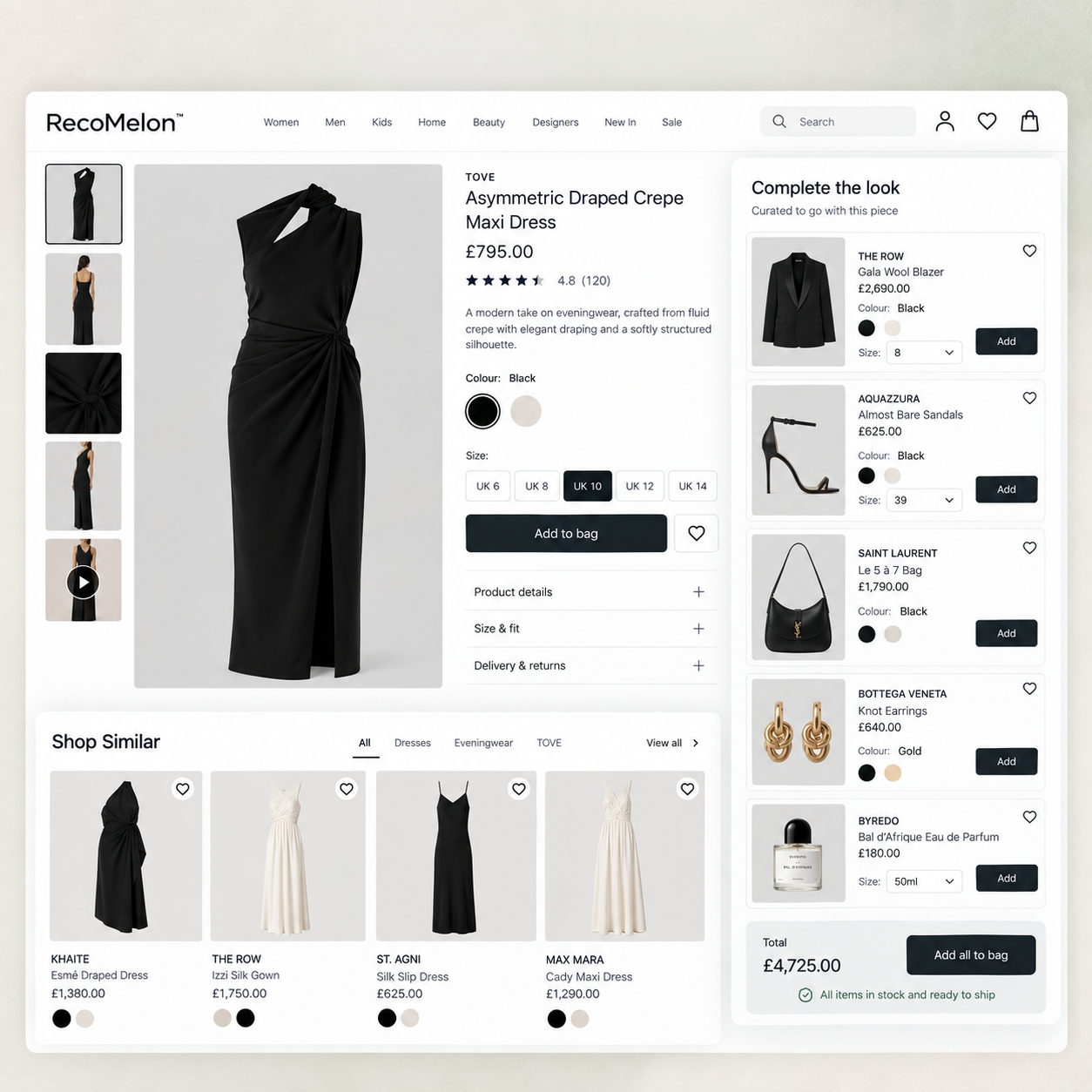
Black evening dress product page with Shop Similar alternatives and a complete-the-look basket containing a blazer, sandals, bag, earrings and fragrance, with live sizes, stock confirmation and add-to-bag controls.

Intent-led personalisation

Personalise from what the shopper is doing now - not only what customers like them bought before.

Large retailers already have behavioural data. The problem is that historical behaviour naturally favours products and brands that have already received exposure.

RecoMelon adds another signal: the product, query and visual direction the shopper is expressing in the current session. That makes it possible to refine discovery around live intent while keeping the retailer’s commercial rules authoritative.

  • Current-session intent

    Carry the shopper’s query, selected product, colour, category, occasion or refinement into the next search result, alternative or complete-look recommendation.

  • Shopper-controlled refinement

    Let shoppers compare alternatives, change variants and swap complementary products rather than forcing them through a fixed recommendation path.

  • Merchant-defined boundaries

    Apply brand, category, stock, market and campaign rules to determine what is eligible for each discovery experience.

  • Storefront-specific presentation

    Configure labels, layouts, controls and calls to action so the intelligence can sit naturally inside the retailer’s existing design system.

Behaviour tells you what has worked before. Live intent helps you respond to what this shopper is trying to do now.

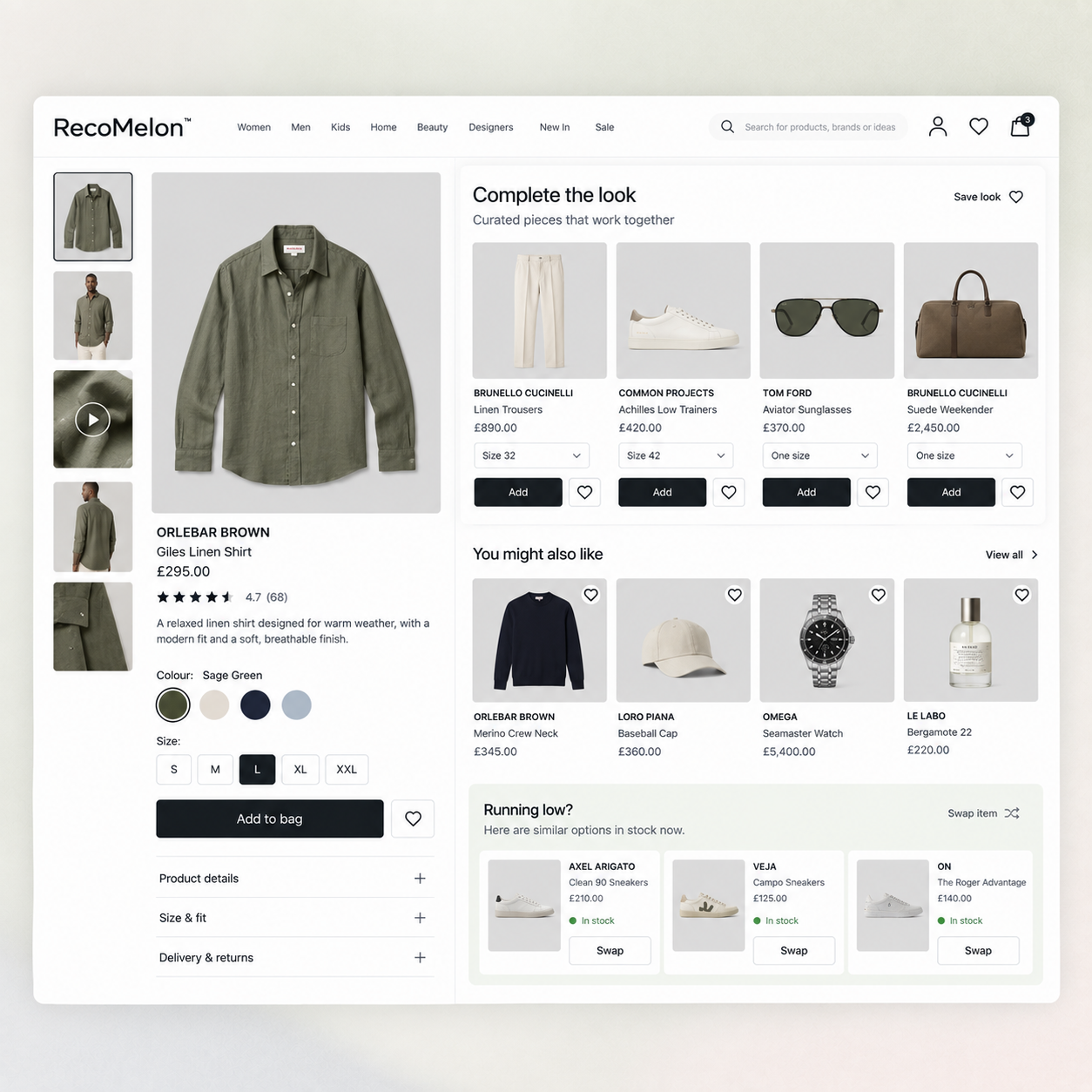
Menswear product page for an Orlebar Brown linen shirt with a cross-brand complete-the-look selection from Brunello Cucinelli, Common Projects and Tom Ford, plus in-stock trainer swaps in a Running low panel.

Enterprise measurement

Measure whether more of the right assortment becomes commercially visible.

For a large retailer, more recommendation clicks are not enough. The useful question is whether discovery exposes relevant products from more of the eligible assortment and turns that additional choice into commercial progression.

  • Catalogue reach

    Measure how much of the eligible assortment enters meaningful shopper journeys, including new arrivals and lower-exposure products.

  • Cross-brand and cross-category exploration

    Track whether shoppers move into relevant products, brands and departments they were unlikely to encounter through the original path.

  • Conversion and order value

    Compare progression to purchase, conversion and basket value against an agreed baseline or control.

  • Merchandising effort

    Include the operational cost of maintaining rules, reviewing matches and managing exceptions. Better discovery should not require an ever-growing manual relationship map.

Use consistent attribution, account for promotions and stock changes, and expand only where the commercial and operational evidence supports it.

Can RecoMelon work across brands, categories and markets without replacing our current search stack?

Compare the platforms when search, recommendations and merchandising need to work across a large or visually complex catalogue.

Bloomreach presents a broad discovery platform. RecoMelon concentrates on making product imagery and catalogue context operational inside Shopify journeys.

What makes RecoMelon different?

RecoMelon builds visual relationships between products and uses them across The Index™ search, Smart Collections, Reveal™ PDP discovery and Bundles™. This can be particularly useful where style, colour, silhouette, pattern or finish affect relevance.

Must Bloomreach be removed first?

No. Scope which platform owns each surface and run a controlled test. RecoMelon can begin with PDP alternatives, a selected collection or complementary-product discovery while the current search stack remains live. No native Bloomreach connector is assumed.

What should procurement evaluate?

Review catalogue preparation, integration ownership, merchandising workload, time to value, regional requirements, explainability, reporting and the commercial result on a representative category.

Yes. RecoMelon can sit across a large retail assortment while respecting the commercial boundaries already used to operate it. Product imagery and catalogue context establish relationships independently of inconsistent brand naming or sparse behavioural history, while retailer rules determine which products, brands, categories, variants and markets are eligible for each discovery surface.

Does this mean removing our current search or merchandising platform?

No. Start where the current experience leaves intent unresolved - cross-brand alternatives, new-product exposure, PDP continuation, collection discovery or complete-look recommendations. Existing search and navigation can remain in place while RecoMelon is evaluated on a defined category, market or surface.

Can merchandising teams control what crosses brand or category boundaries?

Yes. Inclusion, exclusion and merchandising controls can define where cross-brand discovery is useful and where brand, category, campaign or commercial boundaries should remain intact. Catalogue data remains authoritative for price, variants, stock and market availability.

How does this help new arrivals and the long tail?

RecoMelon can establish product relationships from imagery and catalogue context before extensive click or purchase history exists. This gives new collections and lower-exposure products a route into relevant discovery without requiring them to become popular first.

Where should an enterprise retailer start?

Choose a high-choice category where shoppers regularly compare across brands or where a large proportion of the eligible assortment receives little exposure. Establish the baseline for catalogue reach, product exploration, conversion and order value, then expand only where the data supports it.

Find where catalogue depth is becoming invisible choice

Bring your catalogue scale, category structure, markets and current search or merchandising stack. We’ll identify where shoppers are losing access to relevant products, what should remain in place and the lowest-risk surface to test first.

Review our catalogue